Edge AI & IoT for Product Decisions
Level L1 Aware · status alpha · 6 lessons of about 30 minutes · about 3 hours in total · no code, no board
A course for business owners, executives and product owners who must decide whether and how to invest in edge AI and IoT. It does not teach programming. It teaches you to ask the right questions: separate the problems this technology really helps with from the ones it should not be used for, see the full cost and risk before budgeting, and write a brief a development team can act on.
The final deliverable is a one-page decision canvas for your own project.
The lessons are written in Thai; English lesson pages are pending (translation: pending).
Who it is for
Section titled “Who it is for”- Business owners in manufacturing, agriculture, health and retail considering smart devices
- Project managers and product owners who work with developers or contractors
- Educators who want a business-side unit alongside an embedded systems course
Outcomes
Section titled “Outcomes”- Classify business problems as IoT only, IoT with edge AI, or neither, and write a problem statement a technical team can act on.
- Choose an edge, cloud or hybrid architecture with reasons of latency, privacy, cost and connectivity.
- Estimate the three cost parts (one-time, per unit, recurring) and name the team roles required.
- Build a risk register covering cyber security, the PDPA, standards and certification, and the supply chain, naming the agencies to check with.
- Deliver a complete, checkable one-page decision canvas, and credit TESA correctly when sharing the template.
Modules and lessons
Section titled “Modules and lessons”Module 1 — Understand the options (m01-understand-the-options)
| Lesson | Topic | Time |
|---|---|---|
| biz.m01.l01 | What edge AI and IoT can and cannot do | 30 min |
| biz.m01.l02 | Edge, cloud or hybrid | 30 min |
| biz.m01.l03 | Cost, BOM, time and team | 30 min |
Module 2 — Decide and brief (m02-decide-and-brief)
| Lesson | Topic | Time |
|---|---|---|
| biz.m02.l01 | Risk and compliance | 30 min |
| biz.m02.l02 | Build, buy or partner | 30 min |
| biz.m02.l03 | Writing a brief for developers: the one-page decision canvas | 30 min |
Principles
Section titled “Principles”- No market prices or market statistics without a source. Every number in the worked examples is hypothetical and labelled so.
- Laws and standards are cited from official sources, with a reminder that this is not legal advice.
- Every lesson ends with something usable, and together they feed the decision canvas.
Licence
Section titled “Licence”Lesson content is CC BY-NC 4.0; the decision canvas template (in resources/) is CC BY 4.0, so you can use it in your company’s work. The course has no code.
How to cite TESA
Section titled “How to cite TESA”When you use, share or adapt this course or the decision canvas template, credit it as follows:
“Edge AI & IoT for Product Decisions” from TESA Open Knowledge by the Thai Embedded Systems Association (TESA), https://github.com/tesaiot/tesa-qualification-program, licensed under CC BY-NC 4.0
Add “(adapted)” at the end of the credit, with a short note of what you changed, when you change the material. Crediting TESA does not mean TESA endorses your work, service or project. Details and examples are in ATTRIBUTION.md.
Companion videos for this course
Watch on YouTube (opens in a new tab)
-
 Software Development Process - EP01 : Overall Software Development Process Thai Embedded Systems Association (TESA)
 -
 Software Development Process - EP02 : User Needs Thai Embedded Systems Association (TESA)
 -
 Software Development Process - EP03 : System Requirements Thai Embedded Systems Association (TESA)
 -
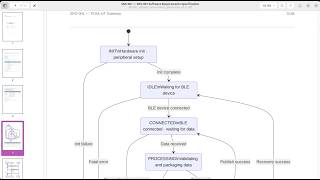 Software Development Process - EP04 : Software Requirements (ต่อ) Thai Embedded Systems Association (TESA)
Videos by Thai Embedded Systems Association (TESA) · The whole series in the playlist AIoT Foundation
TESA Open Knowledge · © 2026 สมาคมสมองกลฝังตัวไทย (TESA) · CC BY-NC 4.0
Content is licensed CC BY-NC 4.0. Reuse it non-commercially and credit the Thai Embedded Systems Association (TESA) every time. · How to cite TESA